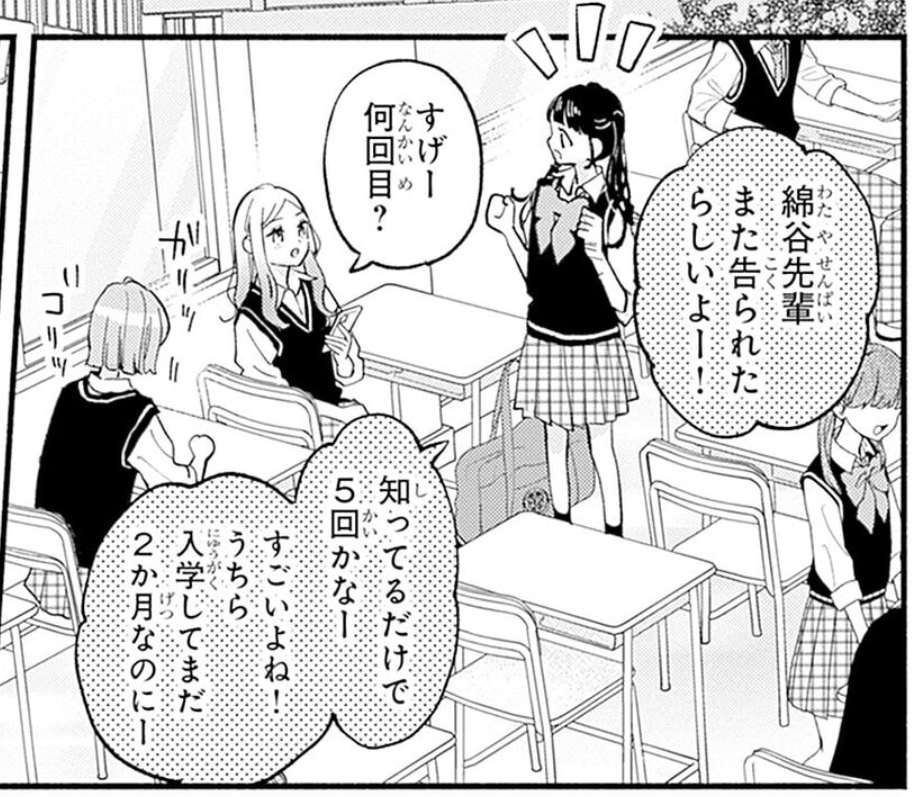
In today’s post, I thought it would be fun to break down this manga panel together!
** For this post, you need to be able to read hiragana, as I won’t be providing romaji readings**
This picture is from chapter one, page 13 of the manga “不可抗力の I LOVE YOU”
Buy the volume for yourself!
*Please note that I am an Amazon affiliate! That means I may make a small commission, at no extra expense to you!*
Word Bank
- 先輩・せんぱい・ upperclassman
- また・again
- 告る・こくる・to confess one’s feelings
- らしい・I hear (rumours, etc.)
- 何回目・なんかいめ・how many times?
- 5回・ごかい・5 times
- 知る・しる・to know
- ずごい・amazing
- うちら・us
- 入学・にゅうがく・entering school
- まだ・still, only
- 2か月・にかげつ・two months
Let’s get translating!
The first sentence is:
綿谷先輩 また告られたらしいよー!
Let’s break this sentence down into two parts.
1
綿谷先輩
- 綿谷 reads as わたや, and is the name of a boy. Japanese names are typically written using special Kanji characters reserved for names, so they may feel a bit unfamiliar at first.
- 先輩 means upperclassman. It’s a suffix added to the end of someone’s name to show respect. It can sometimes be used in place of people’s names.
This part of the sentence reads “Wataya-senpai“, meaning they’re talking about their upperclassman, Wataya.
2
また告られたらしいよー!
- また means again, indicating something that has happened before happened once more.
- 告られる is the passive tense of the verb 告る、to confess. In the passive form, it means that the subject of the sentence was confessed to.
- らしい implies conjecture. Usually, it implies knowledge gained from listening to rumours.
So, we can translate this part of the sentence as: I heard they were confessed to again!
1 & 2
綿谷先輩 また告られたらしいよー!
Now that we know the subject of the sentence, we know who the passive verb 告られる is describing!
We can translated this complete sentence as: I heard Wataya-senpai was confessed to again!
Here’s another look at the panel we’re working on!
Now, let’s take a look at the middle speech bubble:
すげー 何回目?
As this is a fairly short sentence, I think we can look at it all together.
3
すげー 何回目?
- すげー is a colloquial way of saying すごい, meaning amazing. This can be seen as a slightly masculine way to say the word, however it’s commonly used by both male and female characters in high school romance manga.
- 何回目 is a bit of a tricky one! The first Kanji, 何, means “what”—we know this is is a question word from the inclusion of this character. The second Kanji, 回, is a counter for occurrences—we use it to count how many times something has happened. Adding the Kanji 目 to the end of this compound word turns it into a counter for cardinal numbers—counting things or events in a series (for example, first place in a race).
- Let’s take a look at some examples to get a better feel for the previous word:
- 「あのレストラン、何回行ったことがありますか?」would mean “How many times have you been to that restaurant?” This phrase is counting past experiences.
- 「このレストランで晩ご飯を食べるのは、何回目ですか?」would mean “How many times have you had dinner at this restaurant now?” This phrase is counting occurrences, including the current one.
We can translate this sentence as: “Amazing~ how many times now?” or “Wow~ How many times has it happened now?” or “Wo~w what number is that?“.
Moving on to the final bubble! It says:
知ってるだけで5回かなー
すごいよね!うちら入学してまだ2か月なのにー
Let’s break it down and work it out!
4
知ってるだけで5回かなー
- 知ってる is the ている form of 知る。You may be more familiar with it written as 知っている, however colloquially the い is often dropped in writing.
- だけ means only
- 5回 is making use of that occurance counter again! It means 5times.
- かな implies wonder or thinking. The ー attached at the end shows the character is stretching out the final vowel of the word. For example: I wonderrr.
We can translate this sentence as: “Only from what I’m aware of, I thiiiink 5 times.” or “Just from my knowledge, 5 times I think~.”
5
すごいよね!うちら入学してまだ2か月なのにー
- うちら means us, we. It can be seen as a more feminine word.
- 入学 is a compound word that means to start school.
- まだ means still, not yet
- 2か月 is a word that means two months. This one has a few different ways it can be spelt, but it always read the same: 2ヶ月、2ヵ月、二カ月 。Don’t confuse it with 2月, which means February!
We can translate this sentence as: “It’s amazing, isn’t it! Even though it’s only been 2 months since we started school~” or “Isn’t it amazing! And we’ve only been in school for 2 months~“
And that’s it! If you have any questions or comments, please let me know!

 Maddies Manga
Leave a comment