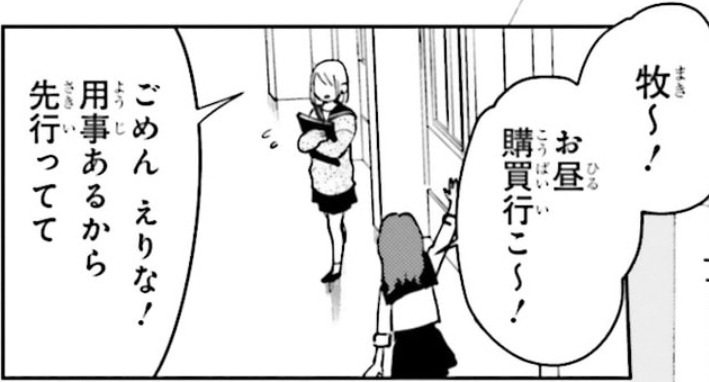
In today’s post, I thought it would be fun to break down this manga panel together!
** For this post, you need to be able to read hiragana, as I won’t be providing romaji readings**
This picture is from chapter one, page five of the manga “スタジオカバナ”
Buy the volume for yourself!
*Please note that I am an Amazon affiliate! That means I may make a small commission, at no extra expense to you!*
Word Bank
- お昼・おひる・lunch
- 購買・こうばい・school store, canteen
- 行く・いく・to go (verb)
- ごめん・sorry
- 用事・ようじ・plans
- 先・さき・before, first
Let’s get translating!
The first sentence is:
牧〜!
お昼 購買行こ〜!
Let’s work out what this means!
1
牧〜!
- 牧 is a person’s name, reading “Maki”. Names in Japanese are often written used special name-only Kanji characters, making them a bit challenging to read at first.
This part of the sentence reads “Maki~!” The ~ at the end of the name shows a friendly tone, as whoever is calling Maki is their friend.
2
お昼 購買行こ〜!
- お昼 is a shorter way of saying 昼ご飯, or, lunch!
- 購買 is the area in a school where you can buy foods to eat. A little different from the 食堂 where you would sit down to eat, the 購買 is where students and teachers can go to buy food.
- 行こう is the volitional form of 行く、to go. It’s written a bit more casually here, as 行こ〜 rather than 行こう—this just again shows friendliness and a bit of bounciness in the speaker’s way of talking.
We can translate this part of the sentence as: “Let’s go buy lunch~!“
1 & 2
牧〜!
お昼 購買行こ〜!
Putting them together, we can translate this sentence as: “Maki~! Let’s go buy lunch~!“
Here’s another look at the panel we’re working on!
Now, let’s take a look at the left speech bubble:
ごめん えりな!
用事あるから先行ってて
3
ごめん えりな!
- ごめん is a very casual way of saying sorry. This is usually only used between friends or friendly classmates.
- えりな is a person’s name. Not all names are written with Kanji!
We can translate this sentence as: “Sorry Erina!“
4
用事あるから先行ってて
- 用事 can be translated a number of different ways: plans, business to take care of, errand, things to do…
- ある means to exist, or to have. 用事ある would mean I have plans!
- から is a conjunction that means because. It explains a situation or reason.
- 先 has several meanings, but when used in front of 行く, it means beforehand, or first. As in “you go on ahead before I do; you go first”.
- 行ってて is a shortened version of 行っていて. This means to continue going somewhere.
We can translate this sentence as: “I have plans so go on ahead (without me).”
3 & 4
ごめん えりな!
用事あるから先行ってて
Putting them together, we can translate them as “Sorry Erina! I have plans, so you go on ahead“
And that’s it! If you have any questions or comments, please let me know!

 Maddies Manga
Leave a comment