After being outed as a magical prodigy, will our villainess be able to prove herself worthy of her talents? While that’s still to be seen, she does prove herself to be capable of not being swayed by blind kindness, as a true villainess should.
Check out a free sample of volume one!
Authors
Genre & Tropes
Info about this series (ongoing)
There are currently three volumes published in English.
My thoughts on this volume (Spoilers!)
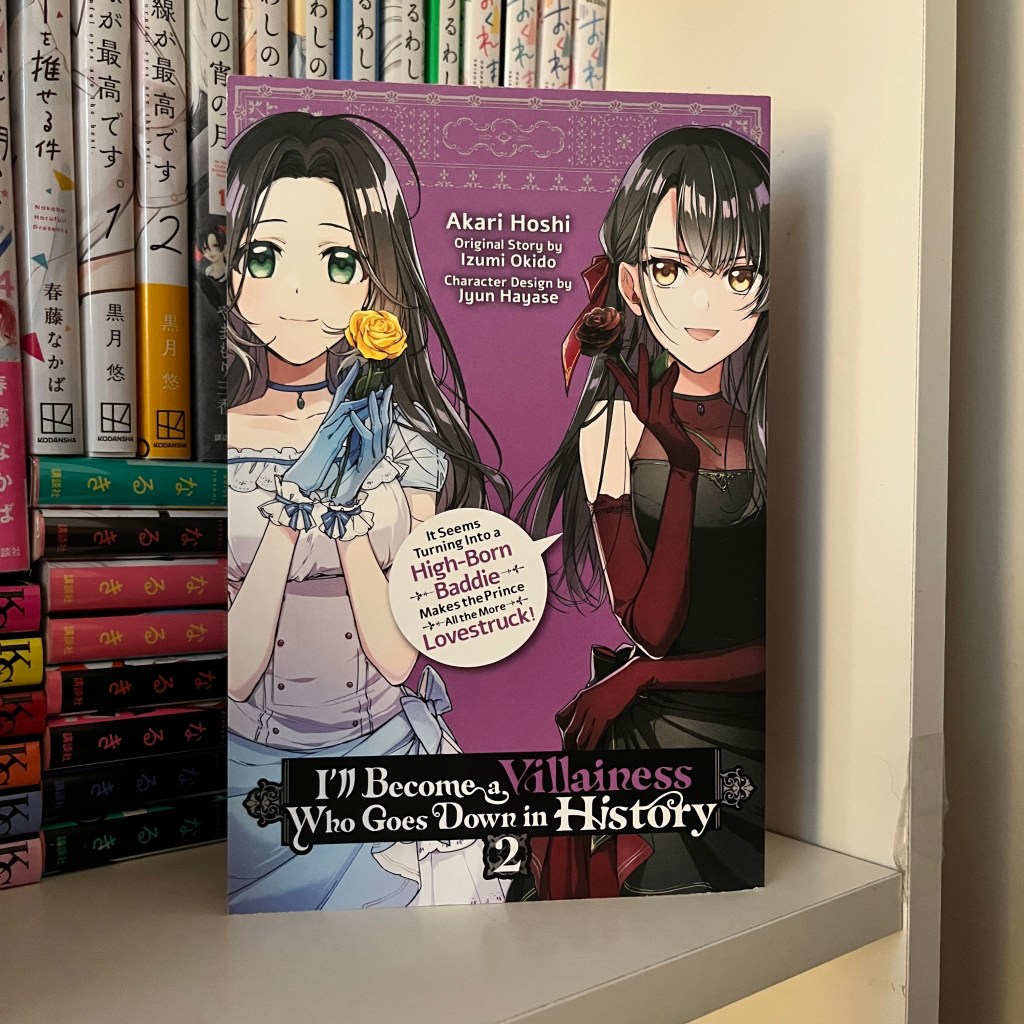
The thing that first piqued my interest in this series was the localization choices the translator made. While the main villainess is referred to as an “悪役令嬢”, or literally, “a villainess” in Japanese, the English translator decided “a high-born baddie” was a more appropriate translation. This was my first time seeing such a linguistic choice, and honestly, it really works with this story. I find it to be rather hilarious at times, with our villainess constantly referring to herself as a “baddie” at the young age of 13.
This volume focuses on situating Alicia’s status as a true villainess, with the king appointing her as the main antagonist to the beloved saintess. Due to her nature as the saint, all she can think of is peace and happiness. Perhaps also due to her nature as the saint, a good majority of the people who interact with her fall in love with her ideals. So much so, that no one dares question her. Ideas like “abolish all jails” and “lend everyone who needs it food and money” could work in an idealistic world, however the real world is much more nuanced than that. Alicia understands this, however the saint does not. This worries the king, as he could never give an official title to someone who is unable to think critically. Thus, Alicia was given her mission. Whenever the saint begins her idealistic preaching, Alicia’s job as antagonist is to try to force her to think things through.
“If you were to abolish all jails, what would you do if a former prisoner attacked an innocent person?” is similar to a question Alicia asks, and the saint can’t give a conclusive answer. She hasn’t thought any of her preachings through—to her, a prisoner would be so grateful to be released that they would give up all evil doings for the rest of their life. Something that is just not realistic.
Thankfully there is a lot less romance between Alicia and Prince Duke. (really, did they have to name him that?) Now that Alicia is a bit older the age gap is slightly more tolerable, however I don’t think this series needs romance. Watching Alicia go about being a “baddie” is entertaining enough without a romantic side-plot. I will say that Alicia capturing Duke’s affection has probably done well to save her from the saints followers at least once or twice. I genuinely find these followers to be scarier than anyone else, as they blindly agree with everything the saint says, and vehemently deny anyone who would disagree with her. Even if a fellow follower were to disagree, they would be instantly shunned from the group. How does the ever-kind saintess not realize just how toxic her group of “friends” is?


Leave a comment