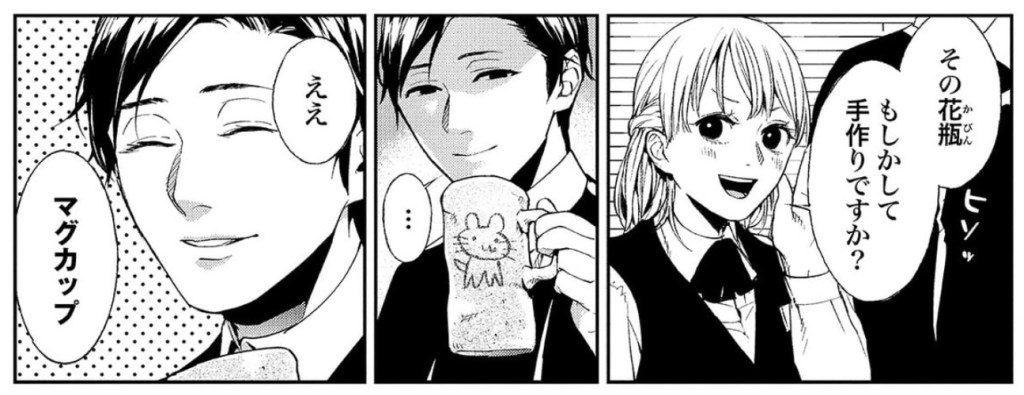
In today’s post, I thought it would be fun to break down these three manga panels together! You may notice that there is no furigana in the above image, and that’s because this is from a josei manga—it’s meant for an older reading audience. Don’t worry if you can’t read some of the Kanji, as I’ll be providing the readings below.
To start, let’s create a word bank so that we understand each of the words.
** For this post, you need to be able to read hiragana and katakana as I won’t be providing romaji readings**
This picture is from volume three of the manga “ブルータル” You can check it out for yourself here!
Word Bank
- 花瓶・かびん・vase
- もしかして・perhaps; could it be that
- 手作り・てづくり・handmade
- マグカップ・mug
Let’s get translating!
The first speech bubble, on the far right, says:
その花瓶
もしかして手作りですか?
As this is a longer sentence, we’ll have to break it down a little bit in order to fully understand it.
1
その花瓶
- その is a word that we use before nouns, to specify location. Think “not this hat, but that hat near you”. その means that (something) near the listener. This word needs to be attached to a noun, we never use it on its own! If you want to learn more about these types of words, this blog has a great article about them!
- 花瓶 means a vase, specifically meant for flowers.
Put them together, and we have “That flower vase (near you, not me)”.
2
もしかして手作りですか?
- もしかして is an adverb that means “maybe?” “could it be?”. It indicates that the speaker is unsure of something.
- 手作り means handmade. If we look at the two Kanji characters found in this word, we have 手, which means hand, and 作, which means to make. So, literally, made by hand.
- ですか is a formal question marker. The speaker is speaking politely to the other person, indicating that they have some level of respect for them, or that perhaps they are above them in a social sphere.
We can translate this part of the sentence as “By chance is it handmade?”
1 + 2
Putting both parts together, we can translate the whole sentence as: “That flower vase, by chance is it handmade?”
Now, let’s take a look at the second set of speech bubbles, in the far left panel!
The second sentence is:
ええ
マグカップ
1
ええ
- ええ is a very casual way of saying “yes”, or just agreeing in general. We can assume that he is either on friendly terms with the person he’s speaking to, or that he is above them in a social sphere.
We can translate this as: “yeah.”
2
マグカップ
- マグカップ is the Japanese word for mug. As in, a coffee mug. Again, he is speaking very informally here.
We can translate this as: “a mug.”
1 + 2
Putting both parts together, we can translate the whole sentence as: “Yeah, it’s a mug.”
And that’s it! If you have any questions, please let me know in the comments below!
If you want any extra Japanese lessons, please check out my Patreon here!

 Maddies Manga
Leave a comment