Today, I’d like to look at some panels from the very short manga: Itoshii Otonari-san !
This is a manga with 15 pages total, telling the story of what a girl went through during the morning of her first day at high school. Together, I’d like to try and work out 3 of these pages!
Important information about this manga
- If you want to read this manga by yourself, you can download it for free here through Amazon Japan!
- This manga does not use furigana (I’ll explain what this means below)
- The author of this manga has released quite a few cute short stories for free through Amazon!
- If you want to read my review of one other their other short manga (about a yankee romance!) you can check it out here!
Some Japanese terminology…
Furigana: phonetic readers that help us read Chinese (Kanji) characters.
「〜〜」: These boxes work the same way that quotation marks do.
Let’s read!
Page one:

Okay, let’s dissect this from top right to bottom left! I’ll also rewrite everything in just hiragana, spaced out underneath to help us read everything!
「同じクラスの彼は いつもお腹を 空かせています」
「おなじ くらす の かれ は いつも おなか を すかせています」
Word bank
| Japanese spelling (with kanji) | Phonetic spelling (with just hiragana) | English reading (romaji) | English meaning |
| 同じ | おなじ | onaji | the same |
| クラス | くらす | kurasu | class |
| 彼 | かれ | kare | him |
| いつも | いつも | itsumo | always |
| お腹 | おなか | onaka | stomach |
| 空かせています | すかせています | sukaseteimasu | empty |
Making use of the word bank, let’s translate this sentence!
「同じクラスの彼は いつもお腹を 空かせています」
“The him from the same class is….always stomach is….empty” could be a more literal translation, but if we want to be grammatically correct, we could say something like
“The boy in my class is always hungry” ! or maybe “The boy in my class’s stomach is always empty”.
Let’s try another page!
Page two part one!

Theres quite a bit more dialog going on here! First, lets only look at the top half – again, reading right to left, up to down.
Our female character says 「そうかな!?」, thinks 「近い近い」, and then says「そんなことは…」
In reply to this, our male character says「朝ちゃんと食ってねえんじゃねえの」。Let’s disect this!
Starting with our female lead, she first says 「そうかな!?」which can be read as “sou kana !?”. This is a very common phrase in Japanese that can mean “I guess!?’ or “I wonder!?”
She then thinks 「近い近い」or 「ちかい ちかい」 which can be read as “chikai chikai”. The word “chikai” means “close” in English, so she’s just thinking “too close!!” in this bubble.
The last thing she says is そんなことは…」or, “sonna koto wa…” which is an incomplete thought, and cannot be properly translated without more context. Because of this, I would translate this as something similar to “the thing is…” or “actually…”, but we can also leave it blank.
Our male lead then says 「朝ちゃんと食ってねえんじゃねえの」he actually has a rather rough way of speaking, that isn’t all that easy to understand if you are just starting to study Japanese!
First, let’s add some spaces in between the words:
朝 ちゃんと 食ってねえん じゃねえ の
this can be read as
あさ ちゃんと くってねえん じゃねえ の
or,
asa chanto kutteneen janee no
word bank
| Japanese reading (with kanji) | Phonetic reading (hiragana) | Standard Japanese translation | English reading (romaji) | English translation |
| 朝 | あさ | あさごはん | asa / asagohan | breakfast |
| ちゃんと | ちゃんと | ちゃんと | chanto | properly |
| 食ってねえん | くってねえん | たべてない | kutteneen / tabetenai | not eating |
| じゃねえ | じゃねえ | じゃない | janee / janai | negative marker |
Making use of the word bank, let’s translate this sentence!
「朝 ちゃんと 食ってねえん じゃねえ の」
“Not properly eating breakfast?” or “Did you not properly eat breakfast?”
Page two part two
Okay! Let’s look at the second half of this panel!
Reading from the right to the left, all the talking is being done by our male character! Remember, he has a rather rough way of speaking, so it can be a little bit hard to understand at first if you’re not used to it.
First he says: コレ 持ってく?
He then says: いーよ どれでも 好きなやつ
On the left-hand side it says: わ〜〜〜 よりどりみどり
His first line :コレ 持ってく?
can be read as : これ もってく? (kore motteku)
or, これ もっていく? (kore motteiku)
「これ」”kore” can be translated as “this” ;
「もっていく」”motteiku” can be translated as “take”
so, we can translate this sentence as “will you take this?” or, “do you want to take this?”
Let’s do a word bank for his second line!
| Japanese reading (kanji) | Phonetic reading (hiragana) | English reading (romaji) | English translation |
| いいよ | いいよ | iiyo | it’s okay |
| どれも | どれも | doremo | any/every |
| 好きな | すきな | sukina | like |
| やつ | やつ | yatu | thing |
Using this word bank as a reference point, we can translate his second line
「いーよ どれでも 好きなやつ」
as: “it’s okay, whichever one you like” or, “it’s okay, pick whichever you like”
the line on the left hand side says: よりどりみどり
or “yori dori midori”
and is a word that means “having one’s pick” implying that our female character is being offered a great deal of different choices.
Page three
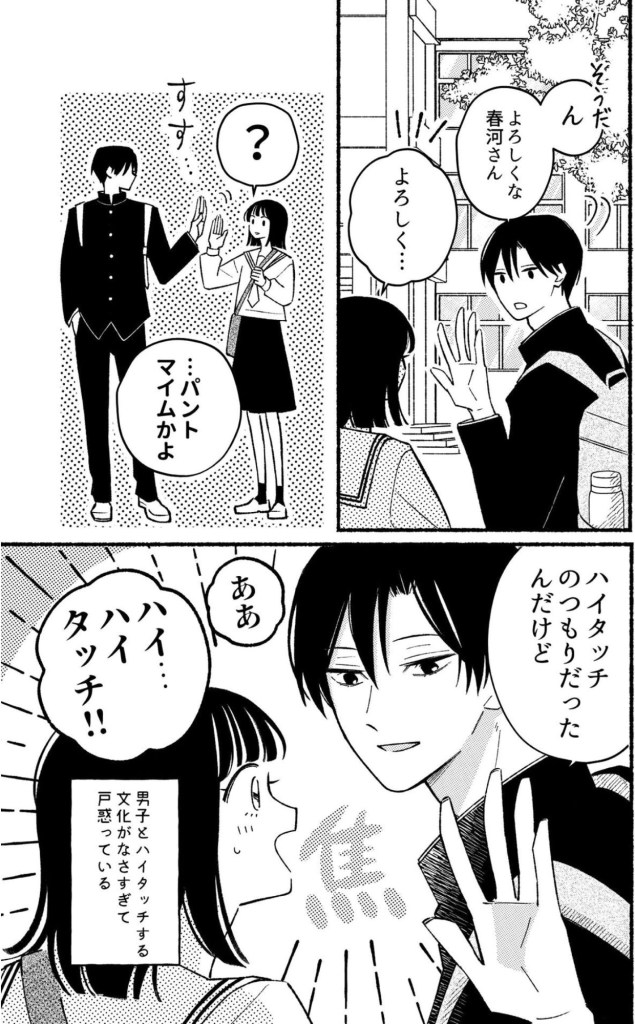
Let’s look at the top half first!
In the top right panel, our male lead says 「ん よろしくな 春河さん」
Our female lead then replies: 「よろしく。。。」
よろしく (yoroshiku) is the short form of the phrase よろしくおねがいします (yoroshiku onegai shimasu) , and means “it’s nice to meet you”
In the top left panel, our male lead then says 「。。。パントマイム かよ」
This can also be written is 「ぱんとまいむ かよ」 or, “pantomime kayo”, if you know that the “ka” at the end of this sentence indicates a question, you may have already translated this sentence as “what are you a pantomime?”.
Now let’s look at the bottom half!
Our male lead first says 「ハイタッチ の つもり だったんだけど」
Our female lead then says 「ハイ。。ハイタッチ!!」
Let’s look at this using another table!
| Japanese reading | English reading (romaji) | English translation |
| ハイタッチ | hai tacchi | hi-five |
| つもり | tsumori | planned |
| だった | datta | past tense marker |
using this table, let’s translate!
「ハイタッチ の つもり だったんだけど」
could be translated as:
“I was planning on a hi-five but…”
and then
「ハイ。。ハイタッチ!!」
could be translated as:
“hi… hi-five!!”
What do you think of this story! Please let me know 🙂

 Maddies Manga
Leave a comment