When it comes to studying language, everyone has their preferences. In my now 6 years of studying Japanese, I have done quite a bit of research on the various types of study materials offered to language learners. In this post, I am going to share what worked for me, and what I wasn’t too fond of. Not just for people who study Japanese, I think the following resources (Besides Maggie Sensei) can be helpful to learners of all languages.
Helpful study resources
Maggie Sensei
Have you heard of Maggie Sensei? She posts very comprehensive lessons on just about every Japanese grammar point there is. Maggie herself is a French Bulldog, and she is at the forefront of every posted lesson.
As textbooks can be overly-academic at times, I find Maggie’s light hearted explanations very easy to digest. She is also very active on her blog, and often replies to comments asking for further clarification.
What really makes her blog stand out, to me, is the sheer number of examples of language in use that she uses in each lesson. Personally, I find it difficult to understand a new word/grammar point until I can see it in action. So having such a resource is invaluable to me.
If you’re interested in Japanese proverbs, why not check out my mini Japanese lesson? You can read it here!
Midori MD
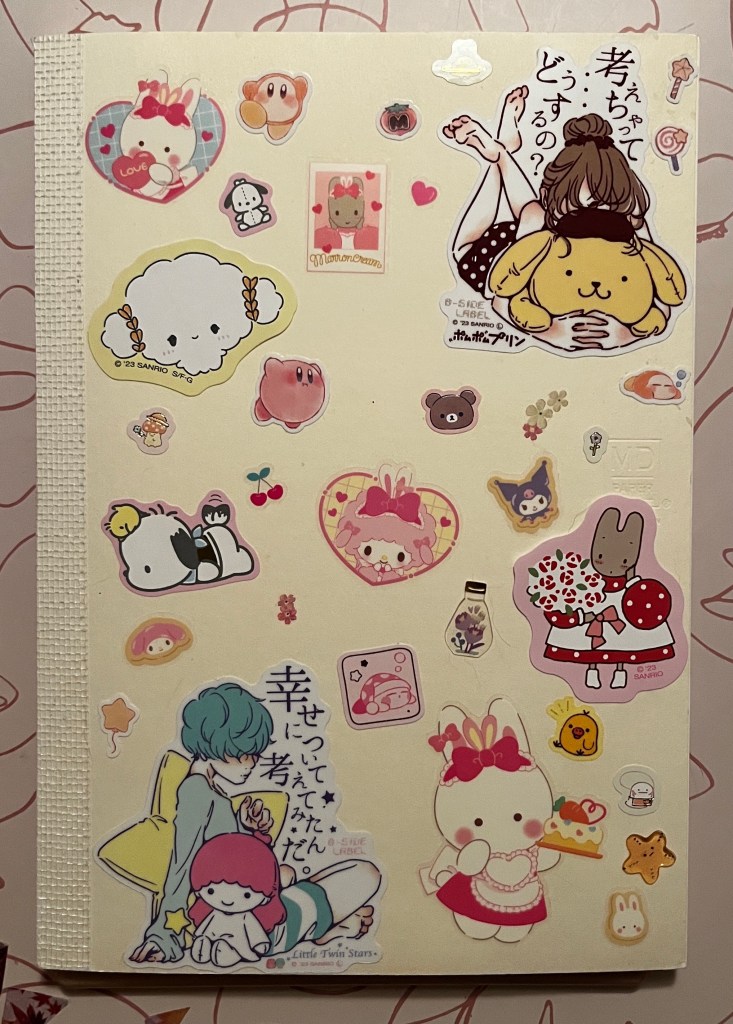
Below is a photo of my notebook! I’m a big fan of decorating everything in my bag, inside and out, so I put as many stickers on it as I could (shout out to B-side Label).
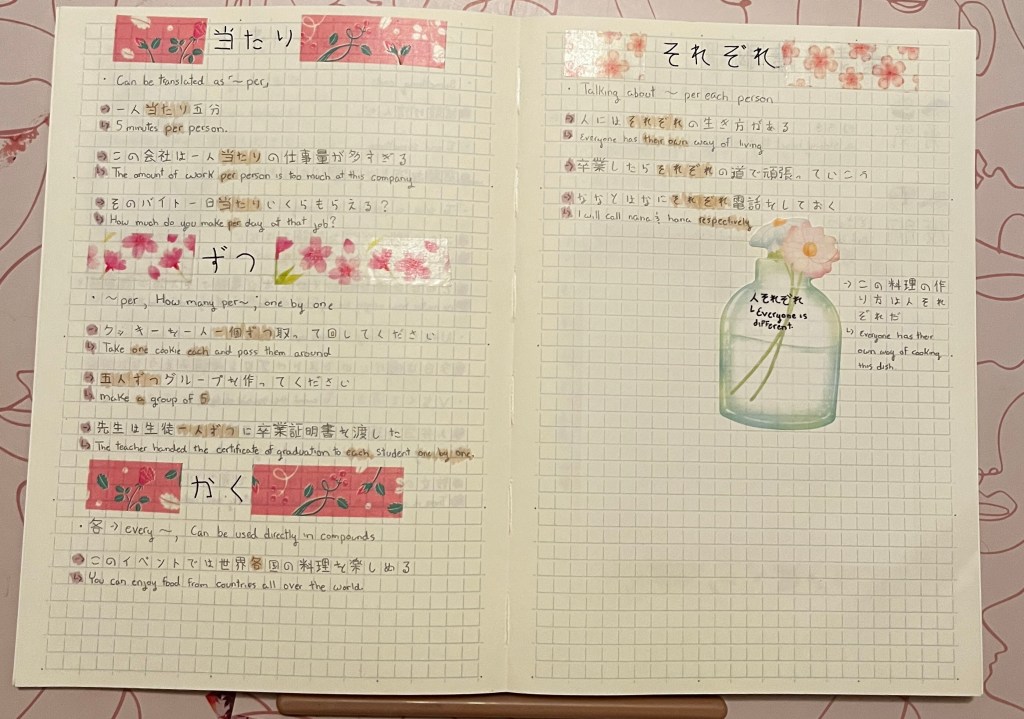
A few notes on why I love this notebook:
- The grid layout is very nice to write on, in both English and Japanese.
- The spine lies flat, making it easy to make full use of all pages.
- Usually, I find the left page annoying to use until I’m at least halfway through a notebook, but I don’t have that problem with this notebook.
- The paper doesn’t bleed.
- It’s compact at its A5 size, making it easy to carry around in my purse.
Of course a notebook on it’s own isn’t a very good study resource, but when used in conjunction with other resources, it really comes in handy. Although nowadays many people prefer using laptops to take their notes, when it comes to Japanese you can’t shy away from old-fashioned hand-written notes.
For a more detailed explanation of this notebook, click here. If you’re Canadian, you can purchase this notebook for ~15$ here.
Quizlet


Quizlet is my go-to study app. A few notes on why I love this app are:
- The interface is very nice to look at (very important if you’re planning on studying for a few hours).
- You can make your own study sets, folders, and classes. This comes in handy when you’re taking class: e.g. Japanese class, unit one folder, class one. If you like to keep your notes organized, this really comes in handy as the sets start to grow.
- There are a variety of study modes featured on this app. While it has the traditional “flashcards”, it also offers mock tests, matching, and an AI-enhanced learn mode.
Nowadays, I use this app primarily in conjunction with whatever novel I’m reading. If there is an especially difficult word, I can put the whole sentence in the answer portion for some extra context.
Quizlet has both a free and paid version. I have used the paid version in the past, but currently I get by with the free version. As it currently costs 9.99CAD a month, I recommend trying out the free version first before jumping in.
Notability


Notability is like the iPad version of a notebook. As I like to keep my notebook nicely organized, I typically first take all of my notes via Notability, and then transfer them over to my Midori MD.
As Notability is the only iPad notebook that I have ever used, I cannot write about how it compares to what else is on the market. I can however write about why I’m happy with my purchase!
- It’s very easy to organize all of the notes taken in Notability. Similarly to how Quizlet is organized, Notability can also be organized into classes, subjects, and notes.
- There are many free templates that you can use! Not just for taking notes, there are templates for journals, agendas, stickers, calendars… It’s fun to browse around and see what the more creative users have made.
LLN
LLN, short for “language learning with Netflix” is just that. It is a method of study that lets you get more immersed in your target language via watching Netflix.
It is incredibly easy to use: You first need to download the LLN plug-in. Once you do, all you need to do is go to Netflix, and choose a show to watch in your target language.
It’s similar to watching Netflix with subtitles, but LLN kicks it up a notch. If I were to use it to watch a Japanese movie, it would automatically show Japanese, and English subtitles at the same time. Not just that, but it also provides furigana (the English reading for Japanese characters). If I were to click on a word I didn’t understand, it would provide me with a simple definition.
Nowadays I turn off the English subtitles, but having clickable Japanese definitions right there at the bottom of the screen time-saving, and doesn’t break immersion.
Other study resources
These are some other often talked-about resources that work for many, but not me.
Paper flash cards
Personally, I find paper flash cards incredibly time consuming. So much so that by the time I’ve finished making them, I’m no longer in the mood to study.
I’ve also lost more cards than I can count, so I prefer to stick to virtual cards.
Anki
In my university Japanese classes, Anki was a favourite among a lot of my classmates. They all raved about its powerful interface, and how it’s such a smart website. Unfortunately, I couldn’t look past the aesthetics of the site. To put it bluntly – it’s not the prettiest.
When I use it on my computer, I find the text incredibly small and hard to read. This then hurts my eyes, and I have to take a break. I know there is probably a way to tailor the cards perfectly to my liking, but I prefer my study materials to be more user friendly from the get-go.
I have also looked into the app, but it’s a little too expensive for me to test out :(.
Duolingo
I love Duolingo for people new to studying a language. Its colourful and cheery lessons, the easy to listen to audio, It’s very easy to just download and jump into.
For me, however, I need to be able to personalize my materials more than Duolingo allows. I prefer materials that are more open-ended, rather than materials that only allow for one correct answer.
I have used Duolingo to polish up my French, however, and I really did enjoy using it to remind myself of some old vocabulary that I had forgotten.
As a last note
There is no one ~perfect~ method to studying. Everyone learns differently, for different reasons. Depending on where you are on your language journey, your preferred study methods will also likely change.
What are your preferred language learning resources?

 Maddies Manga
Leave a comment